
Guide
Credits, explained
What every action costs and how your allowance works.
What a credit is
A credit is the single, weighted unit that meters what your agents produce. Different outputs cost different amounts — a plain text post is light, a video Reel is heavy — so you always know what you're spending, and a small mix of premium content never quietly drains a month.
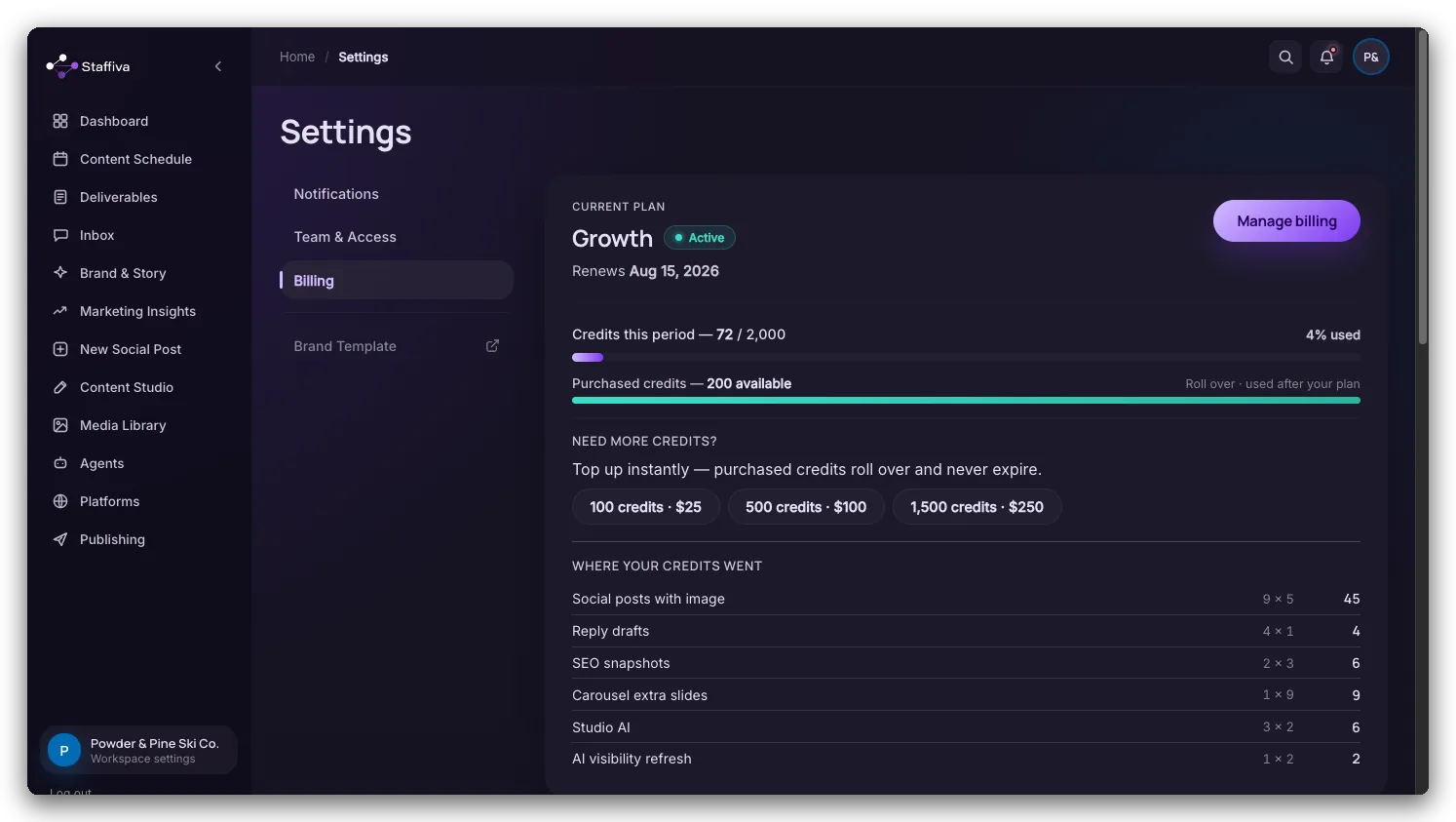
Credits are drawn down as the agents work: Scribe spends them when it drafts a post or writes an article, Scout spends 5 each time it runs a search for leads, or 18 when that search runs on X (an X search pays two data providers instead of one), and Herald spends 1 when it drafts a reply. Reviewing, editing, approving, and connecting accounts are all free.
Planning is free. Laying out a campaign or a content plan — and re-planning it when you change your mind — costs nothing. Credits are spent later, as each beat in that plan is actually written: 2–5 a post, 10 if the plan queues an article.
Ask Staffiva is priced the same way. Asking it how Staffiva works — what a setting does, where a page lives, how something is meant to be used — is free, however many times you ask. An answer that reads your own workspace data (what's scheduled, how last week's posts did, what a number means for you) costs 1 credit, once per answer, wherever you asked it from. A deep analysis that spends real money on fresh data costs 3, and it always quotes that price and waits for you to confirm before it runs.
Your monthly allowance
Every plan includes a pool of credits that resets at the start of each billing period. Plan credits don't roll over — they refresh.
| Plan | Price / month | Monthly credits |
|---|---|---|
| Starter | $150 | 500 |
| Growth | $300 | 2,000 |
| Pro | $600 | 6,000 |
Rough intuition: Starter's 500 credits is about 250 text posts, or 100 posts with images, or 50 articles a month — mix and match however you like.
What each action costs
| Action | Credits |
|---|---|
| Social post (text only) | 2 |
| Social post + image | 5 |
| Social post + video (Reel) | 120 |
| Carousel — each extra slide | +3 |
| Thread / multi-part — each extra part | +1 |
| Article | 10 |
| Article retry (re-runs research, body and hero) | 10 |
| Article section rewrite (AI rewrite of one section) | 2 |
| Herald reply (mention or DM) | 1 |
| Scout run (Reddit and other platforms) | 5 |
| Scout run (X) | 18 |
| Marketing snapshot (SEO refresh) | 6 |
| AI-visibility refresh (monthly) | 2 |
| Studio on-demand social post | 2 |
| Studio on-demand image | 3 |
| Studio image edit | 2 |
| Ask Staffiva answer (about your own data) | 1 |
| Ask Staffiva deep analysis (quoted first) | 3 |
What's deliberately not on that list: planning a campaign or a content plan, reviewing, approving, connecting an account, and asking Ask Staffiva how Staffiva works. Editing text yourself is free as well — typing over a headline, a section or a caption costs nothing. Speaking your question and listening to an answer are free too — you're charged for the answer, once, whether you typed it or said it.
Rewriting an article is generating, not editing. Asking Staffiva to rewrite one section writes a fresh passage, so it costs 2 — the same as a short Studio post. Retrying a failed article costs a full 10, because a retry redoes the whole thing: the research, the body and the hero image. Both are charged when you ask for them, and both are listed above.
One efficiency worth knowing: when Scribe cross-posts the same idea to several networks, it generates one shared image or Reel and writes a caption tailored to each network — so you're charged once for the media, plus a light text cost per network, not once per network for the media. That's why a cross-posted Reel costs far less than generating a separate Reel once per network.
Topping up with credit packs
Need more before your next reset? Credit packs are one-time top-ups you add from Settings. Unlike your monthly allowance, purchased pack credits roll over and stay on your balance until you use them.
| Pack | Credits | Price |
|---|---|---|
| Small | 100 | $25 |
| Medium | 500 | $100 |
| Large | 1,500 | $250 |
You add and manage your card in-app, and buying a pack never takes you out of the app.
The free trial
Your 7-day free trial comes with a flat 150-credit cap so you can try the agents before committing. Credit-pack purchases are held until you're on a paid plan — the trial is for kicking the tires, not scaling up. Once you convert, your full monthly allowance kicks in and packs unlock if you ever need to top up mid-month.
Staying in control of spend
- Usage transparency — every action's cost is shown up front, so nothing is a surprise.
- A cost-aware guardrail — if a single action would push you past your balance, Staffiva blocks that action rather than letting you overshoot.
- Gentle nudges — trial-ending and past-due banners appear in-app, with one click through to your billing portal.